
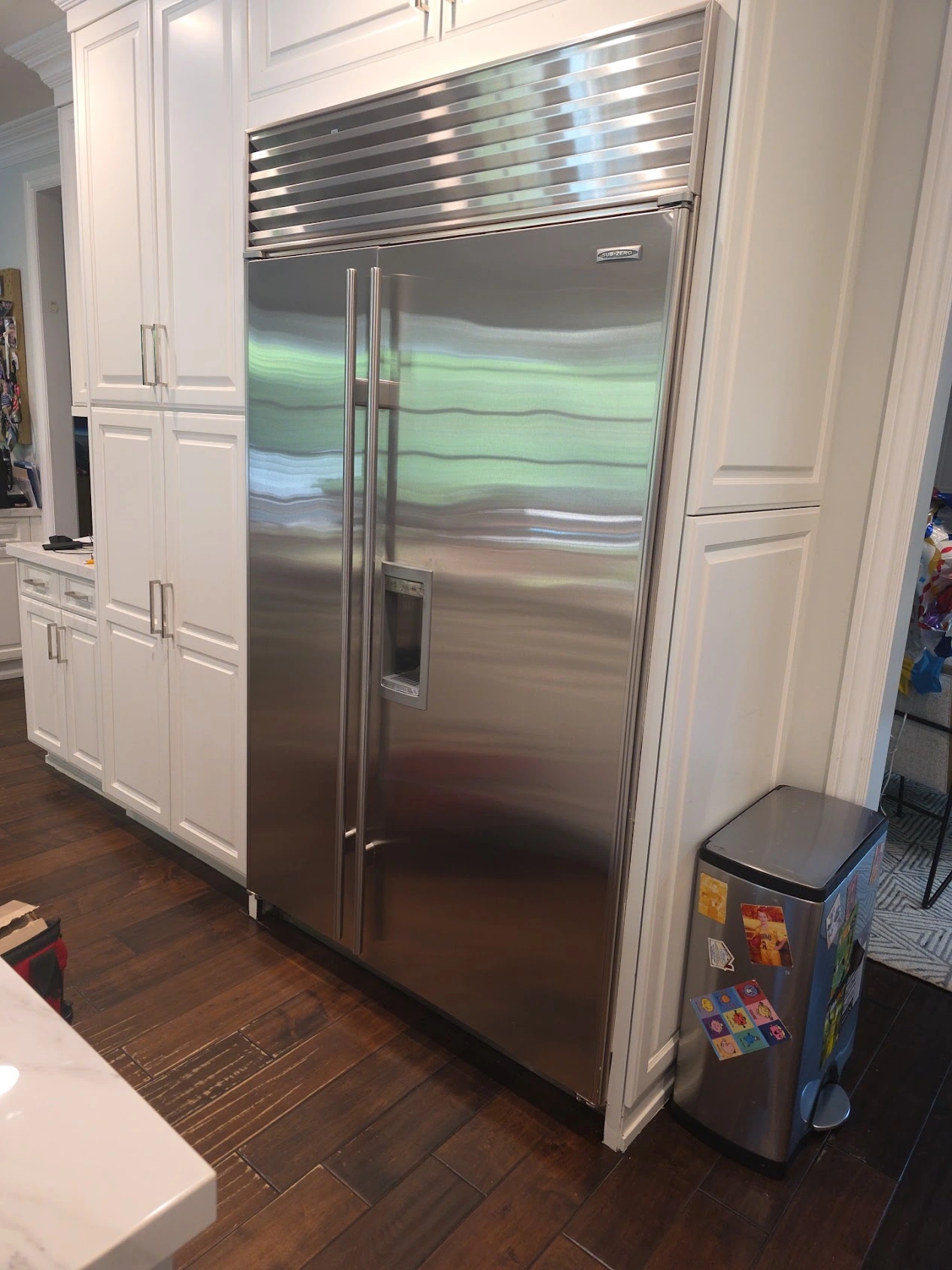
Quick Answer: A Sub-Zero refrigerator not cooling is most often caused by a dirty condenser, a failed condenser or evaporator fan, a defrost problem, a worn door seal, or a bad sensor or control board. Start with the safe checks below. If the compressor is silent, you hear clicking, or you suspect a refrigerant leak, stop and call a professional. Move perishable food to a working cooler if the temperature stays above 40°F.
A warm Sub-Zero is stressful, especially with thousands of dollars of groceries inside. Many Los Angeles homeowners call us after noticing the fridge side is warm, the freezer is soft, or the display shows a rising temperature.
This guide explains the nine most common causes we see on service calls. It covers which problems you can check yourself, what repairs typically cost in Los Angeles, and when to repair or replace. It also covers local factors like Santa Ana dust, heat waves and power shutoffs.
Why Your Sub-Zero Refrigerator Is Not Cooling
A refrigerator moves heat out of the cabinet. The compressor pushes refrigerant through the system. The condenser (the coil that releases heat) dumps that heat into your kitchen. The evaporator (the coil inside the cabinet) absorbs heat from the food compartment, and fans move air across both coils.
If any link fails, the cabinet warms up. The failure can be airflow, electrical, a control problem or, less often, the sealed refrigerant system.
Many Sub-Zero models use separate refrigeration for the fridge and freezer sections. That is why one side can run warm while the other stays cold. It is also why a Sub-Zero fridge not cooling and a Sub-Zero freezer not cooling can have different causes. Check your owner’s manual for how your specific model is built.
Sub-Zero units are usually built into cabinetry. Heat gets trapped around the unit, which makes condenser airflow especially important.
Symptoms, Causes and Urgency
| Symptom | Likely Cause | Urgency | DIY or Call a Pro |
|---|---|---|---|
| Fridge warm, compressor running, freezer cold | Evaporator fan or airflow problem | Medium | Pro (check for blocked vents first) |
| Both sections warm, unit runs constantly | Dirty condenser or condenser fan failure | High | DIY cleaning of the grille area; pro for fan |
| Frost buildup on back wall or freezer | Defrost system failure | Medium | Pro |
| Compressor silent, clicking sound | Start relay or compressor problem | High | Pro |
| Gaps or cold air leaking at door | Worn or damaged gasket | Low–Medium | DIY check; pro replacement |
| Temperature display erratic or far off | Sensor or control board fault | Medium | Pro |
| Warm only after a power outage | Settings reset or long recovery time | Low | DIY |
| Oily residue, hissing, or no cooling at all | Sealed-system leak | High | Pro only |
| Warm and overloaded or vents blocked | Poor airflow from packing | Low | DIY |
The 9 Common Causes in Detail
1. Dirty Condenser Coil
A Sub-Zero dirty condenser is the most common cause of a Sub-Zero refrigerator too warm. Dust and pet hair insulate the coil, so heat can’t escape. The compressor runs longer, temperatures creep up, and parts wear faster. Cleaning is routine maintenance and often restores cooling.
2. Condenser Fan Motor Failure
The condenser fan pulls room air across the coil. If it stops, the coil overheats and cooling drops. You may hear the compressor running with no fan noise nearby.
3. Evaporator Fan Failure
This fan circulates cold air through the compartment. When it fails, the freezer may still feel cold while the fridge side warms up. Ice buildup around the fan is a common sign.
4. Defrost System Failure
The unit periodically melts frost off the evaporator. If a defrost heater, thermostat or sensor fails, frost builds up and blocks airflow. The unit looks like it is running but can’t move cold air.
5. Worn Door Gasket
A torn or hardened seal lets warm air in. You may see condensation along the door edges or frost near the seal. This is often a gradual problem on older units.
6. Faulty Temperature Sensor or Control Board
Sensors tell the control board when to run the compressor and fans. A bad sensor can cause the system to shut off early or not at all. This leads to a Sub-Zero temperature too high reading even when the system is mechanically fine.
7. Compressor Start Components
A Sub-Zero compressor not running is often caused by a failed start relay or capacitor rather than the compressor itself. A clicking sound every few minutes is a classic clue. A technician can test these parts quickly.
8. Sealed-System Leak or Failure
If refrigerant escapes, the unit can’t cool. This is the most serious cause and the most expensive. It requires specialized equipment, and you should never attempt it yourself.
9. Blocked Airflow, Overloading or Power Issues
Food stacked against vents, a tripped outlet or a power interruption can all mimic a failure. These are the easiest to rule out, so start here.
Safe DIY Checks
Safety first: Never open the sealed system, handle refrigerant or gas lines, or work on high-voltage components. Stop and call a professional if you smell gas, see water near electrical parts, see oily residue on lines, or hear buzzing or burning sounds.
- Check the controls. Confirm the unit is on, set to a normal temperature, and not in a demo or showroom mode (some models have one; see your manual).
- Check power. Make sure the outlet and breaker are working. Don’t use extension cords.
- Look for blocked vents. Move food away from interior air vents so cold air can circulate.
- Inspect the door seals. Close a dollar bill in the door. If it slides out easily, the seal may not be sealing.
- Clean the grille area. With the unit on, vacuum the front grille and accessible dust with a soft brush attachment. Don’t pry off panels beyond what your manual allows. If the unit isn’t built-in the same way, follow the manual for your model.
- Listen. Is the compressor running? Are fans audible? Note any clicking, buzzing or silence, and tell your technician.
- Check for frost. Heavy frost on the back wall suggests a defrost problem. Don’t chip it away.
- Verify temperature. Use a separate thermometer. Fridge should be 40°F or below, freezer 0°F.
If steps 1–8 don’t solve it, call a pro. Continued running can strain the compressor.
Repair Costs in Los Angeles
Approximate, varies by model and parts. Ranges include parts and labor, not the diagnostic fee.
| Repair | Approximate Range |
|---|---|
| Condenser cleaning | $150–$300 |
| Condenser fan motor | $250–$550 |
| Evaporator fan motor | $300–$650 |
| Defrost heater, thermostat or sensor | $300–$700 |
| Door gasket replacement | $200–$450 |
| Temperature sensor | $200–$450 |
| Control board | $400–$1,200 |
| Start relay or capacitor | $250–$500 |
| Sealed-system repair or compressor replacement | $1,500–$4,000+ |
What affects the price: model and age, parts availability, whether the unit is built in and requires removal, single versus dual refrigeration, and whether the problem involves the sealed system.
Our diagnostic fee is $85. We provide upfront pricing before any repair begins.
Repair or Replace?
Sub-Zero units are built to last, so repair is often worthwhile. Replacement of a built-in unit can cost well into five figures once installation and cabinetry adjustments are considered.
| Situation | Typical Recommendation |
|---|---|
| Fan, gasket, sensor or cleaning issue, any age | Repair |
| Control board on a unit under about 12 years | Usually repair |
| Sealed-system failure on a newer unit | Often repair |
| Sealed-system failure on a very old unit with other wear | Compare options |
| Repair cost over about 50% of replacement cost | Consider replacing |
| Repeated failures within a short period | Consider replacing |
Ask for the full estimate first. We will tell you honestly when replacement makes more sense.
Los Angeles Factors
- Heat waves and Santa Ana winds. Hot kitchens and wind-driven dust load up condenser coils quickly. Homes in Glendale, Burbank and the Valley see this often.
- Wildfire-related power shutoffs. Utilities may shut off power during high fire risk. Keep doors closed. A surge when power returns can also stress control boards, so consider surge protection.
- Hard water. LA’s hard water can clog filters and water lines, which affects ice makers and dispensers. It’s less often a direct cooling cause, but a clogged line can cause leaks.
- Older homes. Silver Lake and Echo Park homes may have older wiring or outlets that don’t suit premium appliances. Ask a licensed electrician if you have concerns.
- Tight built-in cabinetry. Beverly Hills and Hollywood Hills kitchens often enclose the unit tightly. Poor ventilation raises operating temperature.
- Earthquakes. After a shake, check that the unit is level and the doors still seal.
We serve all of these areas. See our Sub-Zero repair in Beverly Hills page for local details.
Facts and Food Safety Numbers
- Safe temperatures: The USDA recommends keeping the refrigerator at 40°F or below and the freezer at 0°F. (USDA Food Safety and Inspection Service)
- Time limit: Perishable food held above 40°F for more than two hours (one hour above 90°F) should be discarded. (USDA FSIS)
- During outages: An unopened refrigerator keeps food safe for about four hours. A full freezer holds for about 48 hours, and a half-full one for about 24. (USDA FSIS)
- Sub-Zero design lifespan: Check Sub-Zero’s support resources for your model’s manual and details.
Prevention and Maintenance Checklist
| Task | How Often | Why |
|---|---|---|
| Clean the condenser and grille area | Every 6 to 12 months, as Sub-Zero recommends (before summer in hot inland areas) | Prevents overheating |
| Check door gaskets | Every 3 months | Catches air leaks early |
| Verify temperatures with a thermometer | Monthly | Spots drift before food spoils |
| Keep vents clear and avoid overpacking | Ongoing | Maintains airflow |
| Replace water filter per manual | As scheduled | Protects water lines |
| Use a surge protector | Always | Protects boards |
| Schedule a professional tune-up | Yearly | Finds worn parts early |
How ABS Appliance Repair Handles This Repair
We’re independent specialists serving Sub-Zero, Wolf and Cove owners across Los Angeles.
- Call or book. Reach us 24/7 at (323) 344-2725 or book online. Same-day service is often available.
- Diagnosis and clear estimate. We diagnose in your home for an $85 fee. You get upfront pricing before work begins.
- Repair with quality parts. We stock common parts for first-visit fixes whenever possible.
- Test and warranty. We test cooling performance and back repairs with a warranty.
Learn more on our refrigerator repair service.
Frequently Asked Questions
Why is my Sub-Zero fridge warm but the freezer is cold?
Many models cool each section separately. A warm fridge with a cold freezer often points to an evaporator fan problem, blocked air vents, a defrost issue or a sensor fault on the fridge side. Clear the vents first. If it persists, a technician can test the fan and sensors.
How long does a Sub-Zero take to cool down after a power outage?
It can take many hours to return to normal temperature, and the manual for your model gives specifics. Keep doors closed and use a thermometer. If it’s still above 40°F after about a day, there may be a fault. Call a pro.
Is food safe if my Sub-Zero stopped cooling?
Discard perishable food held above 40°F for more than two hours, per USDA guidance. Frozen food that still has ice crystals can often be refrozen. When unsure, throw it out.
How much does Sub-Zero repair cost in Los Angeles?
Common repairs like cleaning, fans and sensors typically run a few hundred dollars. Boards cost more, and sealed-system work can run into the thousands. Our diagnostic fee is $85, and you’ll get an upfront estimate before we proceed.
Why is my Sub-Zero compressor not running?
Common causes are a failed start relay or capacitor, a control board or sensor issue, or a power problem. If you hear clicking or humming, shut it off and call us. Repeated attempts can damage the compressor.
Can a dirty condenser really make my Sub-Zero too warm?
Yes. A clogged condenser traps heat, so the unit runs longer and cools less. Cleaning the accessible grille area every six months helps prevent this. If the fan or coil is the problem, a technician should handle it.
Should I repair or replace my Sub-Zero?
Repair is usually sensible for fans, sensors, gaskets and boards. Consider replacement if the repair exceeds about half the cost of a new unit, or if failures keep repeating. We’ll give an honest recommendation.
How often should I clean a Sub-Zero condenser?
At least every six months, and more often if you have pets or live in a dusty area. Follow your owner’s manual for how to access the grille safely.
Book a Sub-Zero Repair in Los Angeles
If your sub zero refrigerator not cooling problem isn’t solved by the checks above, don’t wait. Warm temperatures can spoil food and strain the compressor.
Call (323) 344-2725 (24/7 emergency calls) or book online.
Service areas: Los Angeles, Hollywood, West Hollywood, Beverly Hills, Glendale, Burbank, Studio City, North Hollywood, Silver Lake and Echo Park.
ABS Appliance Repair, 5545 Carlton Way #110, Los Angeles, CA 90028. Same-day service is often available for Sub-Zero repair in Los Angeles.