
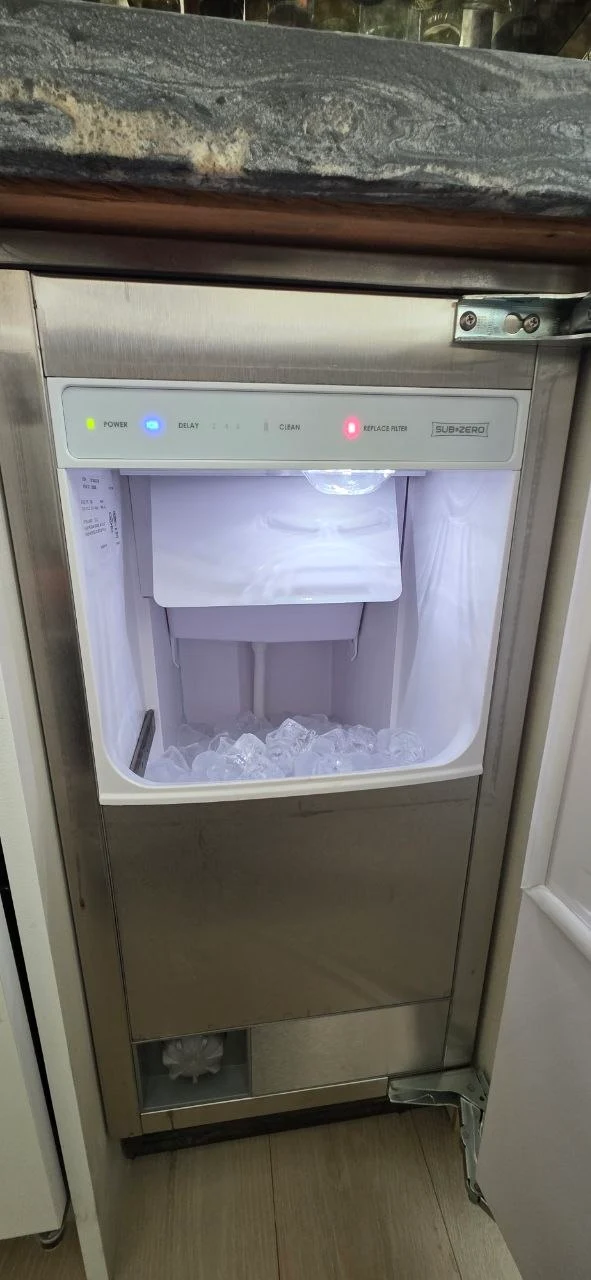
| Quick Answer: A sub zero ice maker not working is most often caused by a switched-off ice maker, a clogged water filter, a frozen or kinked water line, a failed water inlet valve, or a freezer that isn’t cold enough. Start with the safe checks below. If you see water leaking, warm food, or the problem returns, call a professional. |
If your sub zero ice maker not working problem showed up right before a party, you’re not alone. Many Los Angeles homeowners call us when ice slows to a trickle, stops completely, or comes out as one frozen clump.
Most causes are simple and several can be checked in minutes. This guide covers why Sub-Zero ice makers fail, what you can safely check yourself, approximate Los Angeles repair costs, and when to bring in an independent specialist.
Why Your Sub Zero Ice Maker Is Not Working
How the ice maker works
Water travels from your home’s supply line through a water filter and a water inlet valve (an electric gate that opens to let water in). It then flows down a fill tube into the ice mold. When the freezer is cold enough, the water freezes, a small heater loosens the cubes, and the ice maker releases them into the bin.
Why it stops
Ice production needs three things: water, cold air, and working electronics. A problem with any one can stop it. In practice, technicians typically see these causes:
- The ice maker is switched off. It can be turned off at the control panel or by a switch or bail arm, depending on the model. Cleaning, moving, or a power interruption can leave it off.
- A restricted water supply. A clogged filter, a partly closed shut-off valve, or a kinked line can leave the mold underfilled, giving tiny or hollow cubes.
- A frozen fill tube. If water drips slowly or the freezer runs warm, ice can build up in the tube and block it.
- A failed inlet valve. Mineral scale or an electrical fault can keep the valve from opening, so no water arrives at all.
- A freezer that is too warm. Ice needs a freezer near 0°F. If the freezer can’t hold that, the ice maker won’t produce properly.
- A faulty ice maker module. The electronic component that runs the freeze and release cycle can wear out over time.
Many Sub-Zero models also have separate refrigerator and freezer systems, so a warm fresh-food section doesn’t always mean the freezer is affected. Only a technician should check the cooling system itself.
Table 1: Symptoms, Likely Causes, and Urgency
| Symptom | Likely Cause | Urgency | DIY or Pro |
|---|---|---|---|
| No ice at all | Ice maker turned off, closed water valve, failed inlet valve | Medium | DIY checks first, then Pro |
| Small, hollow, or thin cubes | Clogged filter, low water pressure, partly frozen line | Low | DIY filter and line check, then Pro |
| Ice in one big clump | Humidity, infrequent use, melting and refreezing, door left ajar | Low | DIY (empty the bin) |
| Water pooling under or inside the unit | Loose or damaged line, overflowing mold, cracked fill tube | High | Pro (shut water off first) |
| Ice tastes or smells bad | Old filter, stored odors, dirty bin | Low | DIY |
| Ice maker runs but never fills the bin | Jammed ejector, failing module, freezer too warm | Medium | Pro |
| Freezer or fridge warming up too | Cooling system or fan problem | High | Pro right away |
| Loud clicking or buzzing | Failing inlet valve or motor | Medium | Pro |
Safe DIY Checks
These checks involve no tools, panels, gas, or electrical components. Always check your Sub-Zero owner’s manual for your model’s specifics.
- Confirm the ice maker is on. Check the control panel or switch and make sure ice production is enabled.
- Check the freezer temperature. It should be around 0°F. If food is soft or partly thawed, skip to the warning below.
- Make sure the doors seal. A drawer or door left ajar lets in warm air and humidity, which causes clumping and slow production.
- Empty the ice bin. Discard old ice, wipe the bin, and look for jammed or fused cubes.
- Check the water filter. If it’s past its replacement date (typically about every six months, per Sub-Zero guidance), replace it with a correct filter.
- Inspect the visible water line. Look for kinks where the unit meets the wall and make sure the shut-off valve is fully open.
- Wait 24 hours. After a filter change or restart, give the unit time to produce a new batch.
- Check for power interruptions. Resetting after an outage may resume production. Follow your manual’s reset steps.
| Stop and call a professional if:You see water leaking or pooling. Shut off the water supply and call us.The freezer or refrigerator is not holding temperature. This may involve the sealed system (the refrigerant circuit). Never attempt to open it.You smell burning, see sparking, or find damaged wiring. Do not touch electrical parts.Ice or frost builds up around the fill tube again after you clear it.Never chip ice with sharp tools or use a heat gun near plastic parts. You can damage the unit or void parts coverage. |
Table 2: Typical Repair Costs in Los Angeles
Approximate, varies by model and parts. Ranges include parts and labor.
| Repair | Approximate Range |
|---|---|
| Diagnostic visit (in-home) | $85 |
| Water filter replacement (filter cost + service) | $100 – $250 |
| Water line or shut-off valve repair | $150 – $350 |
| Fill tube or heater repair | $200 – $450 |
| Water inlet valve replacement | $250 – $550 |
| Ice maker module/assembly replacement | $400 – $1,000 |
| Sealed system repair (if cooling is the root cause) | $1,200 – $3,000+ |
What affects the price: your model and year, parts availability, whether the issue is the ice maker or the cooling system, how many components are involved, and access to the unit. Built-in installations may need more time to reach the parts. We give an upfront estimate after the in-home diagnosis, before any repair begins. Learn more on our Sub-Zero ice maker repair service page.
Repair vs. Replace
Sub-Zero units are built for long service lives, and ice maker problems are usually among the less costly repairs. As a general guideline, repair makes sense when the cost is well under half the price of a comparable new unit.
| Situation | Typical Recommendation |
|---|---|
| Filter, valve, line, or fill tube issue on a unit of any age | Repair |
| Ice maker module failure on a unit under about 15 years old | Repair |
| Sealed system failure on a newer unit | Often repair, discuss options |
| Sealed system failure on a 15+ year old unit | Compare repair cost to replacement |
| Repeated failures across multiple systems | Consider replacement |
We’ll give you an honest recommendation. If repair isn’t worth it, we’ll say so.
Los Angeles Factors That Affect Ice Makers
- Hard water. Los Angeles tap water is typically hard, and mineral scale can clog filters, inlet valves, and fill tubes. This is a common reason for ice problems in Hollywood, Silver Lake, and Echo Park.
- Heat waves. In Studio City, Burbank, North Hollywood, and Glendale, summer heat makes freezers work harder, and a warm kitchen can slow ice production.
- Older homes. Aging plumbing in Echo Park or Silver Lake can mean inconsistent water pressure and sediment, which affect fill and ice quality.
- Power shutoffs and outages. During high-wind fire weather, utilities may cut power. Outages can leave controls off or the freezer warm, so check your unit afterward.
- Earthquakes. Even minor shaking can shift a built-in unit or loosen a water connection. Check for leaks afterward, especially in Beverly Hills and West Hollywood luxury installs with tight cabinetry.
- Dust. Dust on condenser areas makes the system work harder. Keep the surrounding area clean.
Facts and Figures
- Safe temperatures: The USDA Food Safety and Inspection Service recommends keeping the refrigerator at 40°F or below and the freezer at 0°F. (USDA FSIS,)
- Outage food safety: USDA guidance says a full freezer holds safe temperatures for about 48 hours (24 hours if half full) if the door stays closed, and a refrigerator for about 4 hours. (USDA FSIS,)
- Design life: Sub-Zero has described its refrigeration products as designed for long service lives, often cited as around 20 years.
- Water hardness: Hard water is a recognized cause of scale buildup in appliances.
Prevention and Maintenance Checklist
| Task | How Often | Why |
|---|---|---|
| Replace the water filter | About every 6 months (check your manual) | Protects water flow and ice quality |
| Empty and clean the ice bin | Every 3 to 6 months | Prevents odors and clumping |
| Check door and drawer seals | Quarterly | Keeps humidity and warm air out |
| Check freezer temperature | Monthly | Ice needs a steady 0°F |
| Inspect visible water line for kinks and leaks | Twice a year | Catches problems before water damage |
| Keep the surrounding area dust-free | Quarterly | Helps the system run efficiently |
| Schedule a professional checkup | Annually | Finds worn parts early |
How ABS Appliance Repair Handles This Repair
We are independent specialists serving Sub-Zero, Wolf and Cove owners across Los Angeles.
- Call or book. Reach us at (323) 344-2725 or book online. 24/7 emergency calls are taken, and same-day service is often available.
- In-home diagnosis and clear estimate. For an $85 diagnostic fee, we inspect the unit and give upfront pricing before any work.
- Repair with quality parts. We stock common parts, which often allows first-visit repairs.
- Test and warranty. We test ice production and temperatures, and back our repairs with a warranty.
FAQ
Why is my Sub-Zero ice maker not making ice?
Common reasons include the ice maker being switched off, a clogged filter, a closed or kinked water line, a failed inlet valve, or a freezer that isn’t cold enough. Check the switch, filter, and water supply first. If those look fine, a technician can test the valve and module.
How long does a Sub-Zero ice maker take to make ice?
After a restart or filter change, it can take about 24 hours to produce a full batch. Timing varies by model and freezer temperature. If nothing appears after a full day, there is likely a water supply or component issue worth diagnosing.
Why is my Sub-Zero ice maker making small or hollow cubes?
Small or hollow cubes usually mean not enough water is reaching the mold, often from a clogged filter, partly frozen fill tube, or low water pressure. Replacing the filter and checking the supply line are good first steps. If it persists, have the inlet valve tested.
Why is ice clumped together in my Sub-Zero freezer?
Clumping usually comes from moisture and temperature swings: a door left ajar, ice sitting unused for long periods, or partial melting and refreezing. Empty and dry the bin, confirm the door seals, and check the temperature. Frequent clumping can signal a freezer issue.
How often should I change my Sub-Zero water filter?
Sub-Zero guidance generally points to about every six months, though your model’s manual or indicator is the best guide. In Los Angeles, where hard water is common, a fresh filter helps protect water flow and ice quality.
How much does Sub-Zero ice maker repair cost in Los Angeles?
Approximate costs range from about $100 for filter service to $1,000 for a module replacement, with sealed system work higher. Our diagnostic visit is $85. Exact pricing depends on model, parts, and cause, and we provide an upfront estimate before repairing.
Is it safe to fix a Sub-Zero ice maker myself?
Basic checks like the switch, filter, bin, and door seals are safe. Do not open panels, handle electrical parts, or touch the sealed system. If water is leaking or the unit isn’t holding temperature, shut off the water and call a professional.
Do you offer Sub-Zero ice maker repair near me?
We serve Los Angeles, Hollywood, West Hollywood, Beverly Hills, Glendale, Burbank, Studio City, North Hollywood, Silver Lake, and Echo Park. Same-day service is often available, and 24/7 emergency calls are accepted at (323) 344-2725.
Don’t Live With a Sub Zero Ice Maker Not Working
Most ice maker problems are fixable, and an early diagnosis often costs less than waiting. Our independent technicians diagnose in your home, give upfront pricing, and back repairs with a warranty.
- Call: (323) 344-2725 (24/7 emergency calls, same-day service often available)
- Book online: Schedule your repair
- Address: 5545 Carlton Way #110, Los Angeles, CA 90028
- We serve: Los Angeles, Hollywood, West Hollywood, Beverly Hills, Glendale, Burbank, Studio City, North Hollywood, Silver Lake, and Echo Park. See our Beverly Hills